
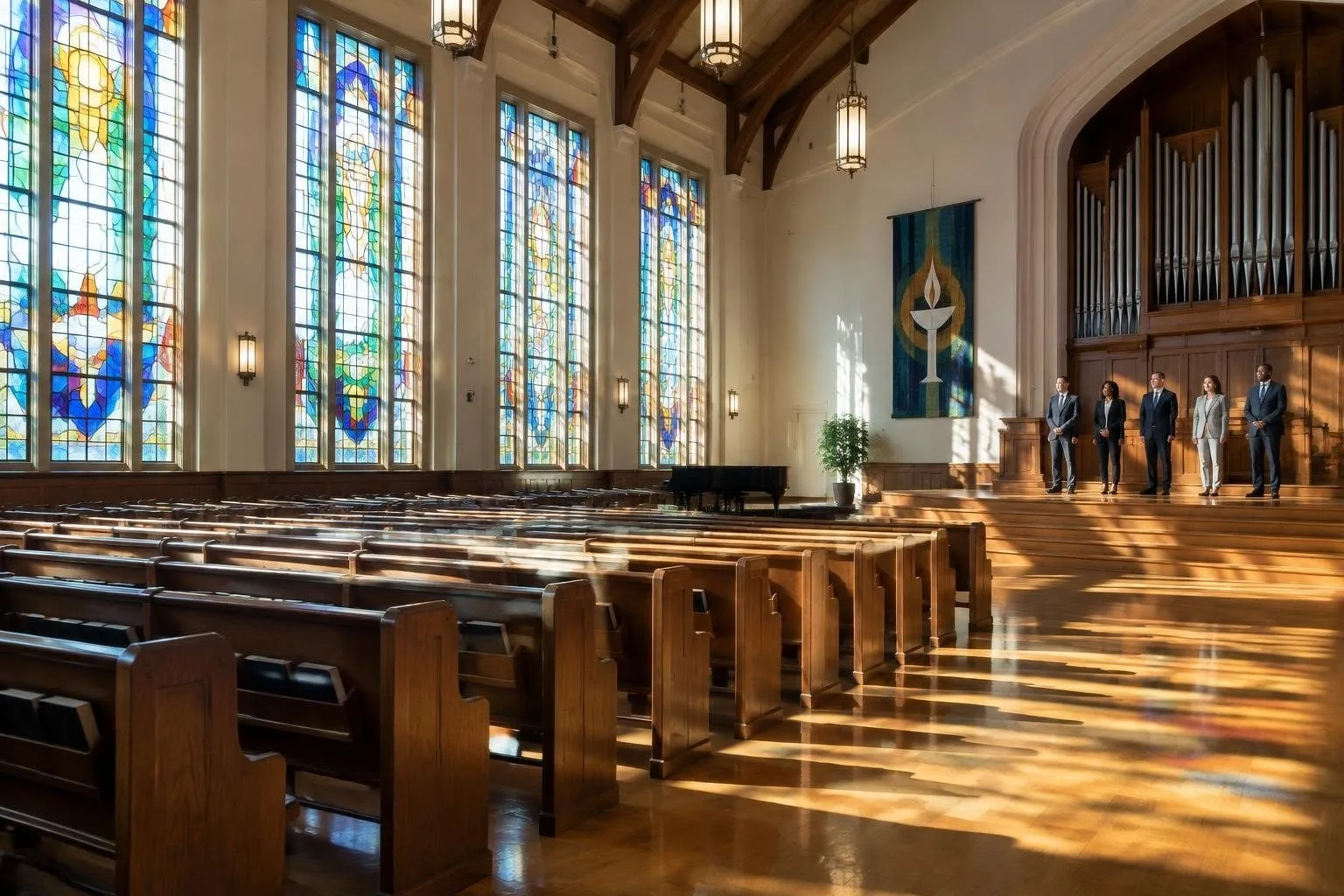
On a Saturday afternoon, roughly two hundred Evanston residents gathered inside the main hall of the Unitarian Universalist Congregation of Evanston, 1330 Ridge Ave, to hear five mayoral hopefuls answer questions on transportation and climate policy. The session, organized jointly by the Evanston Transit Alliance and Climate Action Evanston, lasted about two hours and was moderated by Nathaniel Al-Najjar and Gulnaz Saiyed, who presented pre-written queries from their respective groups.
The gathering served as the first joint appearance of most candidates before the special election slated to fill the remainder of former Mayor Daniel Biss’s term. Biss resigned on Oct. 18 to concentrate on a congressional bid, triggering a primary on Feb. 23 and a likely runoff on April 6. The forum thus offered voters a chance to compare platforms side-by-side before the ballot.
Who took the stage and why one was missing
Five of the six declared candidates appeared on the dais: former corporate project manager Jeff Boarini, City Clerk Stephanie Mendoza, former Councilmember Jane Grover (who now works for the Chicago Metropolitan Agency for Planning), author and equity consultant Gilo Logan, and Central Street Neighbors Association President Jeff Smith. The sixth contender, former Councilmember Ann Rainey, could not attend due to a prior commitment and submitted her answers in writing. Each participant used the limited time to highlight personal experience and to differentiate how they would translate that experience into municipal action.
Common ground on transit expansion and climate initiatives
Across the board, candidates agreed that Evanston should push for a more robust east-west transit service. They emphasized the need to move beyond the 2014 Bike Plan and to enforce a stronger implementation of its update. Jane Grover pointed out that many funding streams for bike and pedestrian projects are administered by the Chicago Metropolitan Agency for Planning, and that misaligned resources often stall progress. “It’s important to understand how these projects are funded and establish good, healthy relationships with those funding sources,” she said, underscoring the timing of fund flows as a critical factor.
Stephanie Mendoza highlighted the gap between approval and execution, noting that the original Bike Plan has lingered without full rollout. She promised to act as a “partner at the dais,” encouraging city staff to propose innovative ideas without fearing failure. “We also have the responsibility to ensure that our staff feel comfortable with bringing forward new ideas,” Mendoza asserted, stressing a culture of experimentation.
Jeff Boarini focused on accountability, suggesting public scorecards, dashboards, and regular staff reports to City Council as tools to keep projects on schedule. He pledged that the city manager’s performance review would include implementation of recommendations from the recent environmental equity investigation, thereby institutionalizing oversight.
Accountability, university relations, and the push for new leadership
When the conversation turned to large-scale building compliance, especially regarding the Healthy Buildings Ordinance, Jeff Smith warned that northwestern university must be held to the same standards as any other property owner. Drawing on his legal background, Smith proclaimed, “Speaking truth to power is sort of my brand,” and invoked Northwestern’s recent nearly-billion-dollar football stadium as evidence of its fiscal capacity.
Gilo Logan, the sole first-time candidate, echoed the need for relationship-building alongside penalties. He argued that a fresh mayoral voice could forge a new partnership with Northwestern’s newly appointed president, positioning the city to both hold the university accountable and collaborate on climate goals.
Overall, the forum presented a clear picture: while candidates converge on the importance of expanding transit, tightening bike-plan execution, and scaling up the Green Homes energy-efficiency pilot, they diverge on the mechanisms for enforcement and the political style they would bring to the office. Voters now have a concise set of contrasts to weigh before heading to the Feb. 23 primary.